Art Books
Chris Kraus: Social Practices
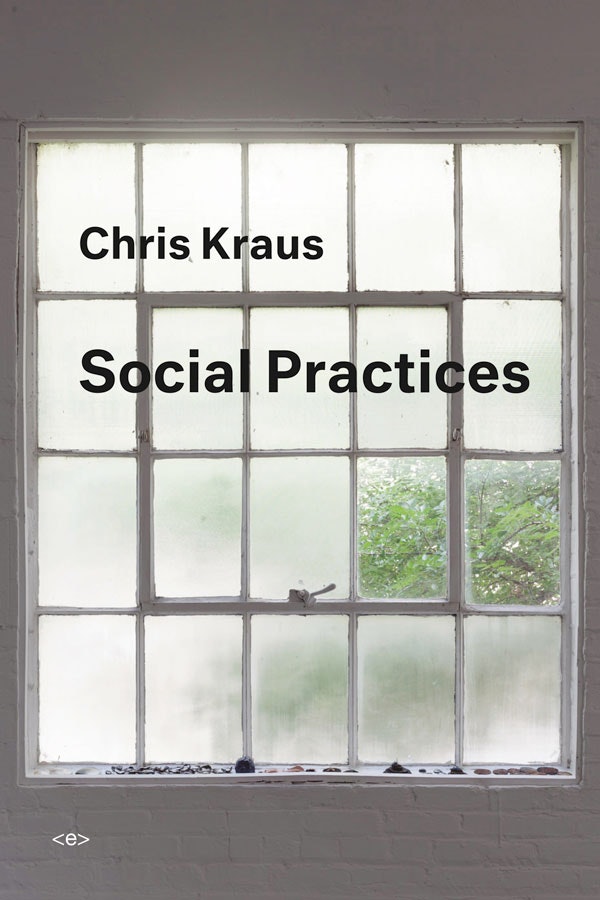
If the last decade or so of social practice art has presented artists
with different ways of working in the world—not unaffected by history,
not without compromise or complicity with the art world, not without
material—then Social Practices by Chris Kraus,
published by Semiotext(e), takes a different position. Kraus's book is
not about social practice art, necessarily, but her selection of essays
and interviews unfolds social practice projects and some of the
persistent debates that come to occupy its discursive and critical
sites. The collection is composed of previously published essays and
interviews written over thirteen years (although some of the events take
place in the 1990s). It is cut through with tensions of art world
success, premature death, and the social and economic issues confronting
artists and culture at large—displacement, gentrification, debt—along
with questions of how artists are to live and work within these
conditions. Kraus exposes the visible cracks of social practice and the
institutional structures on which they hinge. Her writing is
conversational yet critical, engaged yet incisive, with elements of
chance, memory, and travel animating each entry. Instead of chronicling
each essay, I follow some of the patterns of social practice she forms
throughout the collection, as well as her writing about Los Angeles and
environs, highlighting successes and failures of the genre.
The term "social practice" itself has its roots in psychology and refers
to how one's practice engages with social contexts through activities
and critical inquiries: it's a methodology, a way of doing things.
Coupled with "art," social practice takes the "social" as its medium, in
form and content (engaging with societal, economic, and political
issues) and involves finding new ways to work with communities,
audiences, and publics on short- and long-term projects. As historian
Grant Kester has pointed out, it has become the institutionalized
version of socially and politically engaged artwork and arguably also
the community arts tradition. It stems from a desire to create art that
makes a difference, to be relevant as an artist, to form alternative
economies, and to find a way out of the highly commercialized art world.
Social practices constitute an aggregation of methods, and Kraus argues
this is partially due to a professionalizing of art and the dissolution
of the humanities. As a consequence, these orphaned disciplines migrated
to the fine arts, distinctive from community arts, but more relevant
than the "social utopias" and gallery-based work of Nicholas Bourriaud's
relational aesthetics. And so, in 2005, California College of the Arts'
Art & Social Practice MFA was born filled with well-intended
students—artists, activists, and designers clamoring on about
participation, social justice, intervention, community, publics, and
aesthetics. As social practices gained popularity, projects that
sometimes do nothing more than create temporary situations, often rather
convivial, and which have been absorbed into participatory culture,
have become the face of this genre. This shift, for Kraus, has led to a
lack of credibility, causing many artists to distance themselves from
its nomenclature while still benefiting from the commercial and
educational structures supporting the discipline. Thus the term
"socially engaged art" is used more often, which mandates a social or
political engagement (though all social practices need not be
political); it's not political art, but doing art politically.
Kraus's case studies unfold against the mysterious geography of Los
Angeles, so vast and filled with promise and lost dreams. She excavates
LA's 1990's art scene as it transformed from artistic outpost to the
global city it has become. "A Walk around the Neighborhood" takes
readers through Mt. Washington (an artist enclave northeast of Los
Angeles) to stand on the balcony of a Craftsman Bungalow and encounter
artist Delia Brown and her Pastorale—a rumative film about
youth and privilege—as we bask in the California sun. In Highland Park,
we meet artist Daniel Mendal-Black as he details the changing nature of
his gentrifying neighborhood. Down through Chinatown and Bunker Hill we
pass through Joel Mesler's gallery Pruess Press and learn about how, in
the early 2000s, musicians and artists gathered and recorded on their
own terms, in defiance of the music industry during a time before the
area's redevelopment. Her journey chronicles the way artists witness,
document, and respond to these shifts in their neighborhoods. The
performative, collective, or communal artwork finds its roots in
cultural traditions tethered to the local.
"Kelly Lake Store" describes a project (ultimately rejected by the
Guggenheim Foundation) in Minnesota where Kraus proposed making a
country store into an artwork. The store would highlight the
depopulation and dereliction of small towns across the U.S. and include
an operating business on the vacant lot, bringing students in to
participate and local residents to work the shop. Her Guggenheim
proposal resonates with many artists whose practices draw attention to
and hope to ameliorate pressing issues confronting urban and rural
communities. Kraus's essay suggests students enter MFA programs to
become teachers, archivists, and small business owners because these
types of community-centered activities are no longer valued, but find
visibility in contemporary art's elastic discourse and definition.
"Radical Localism" confronts the specific challenges facing border
towns. Kraus presents a portrait of Marco Vera's Mexicali Rose, a
neighborhood center with long time ties to the area. The center
programmed video classes, art exhibitions, and a film club in Pueblo
Nuevo near the Mexicali border. Mexicali Rose lasted five years, and
during that time, it "strengthened existing ties amongst residents of
the Pueblo Nuevo community and created a larger one of its own." These
aren't artists coming in to do work (the proverbial "fly in fly out"
kind); they are from the area, invested in maintaining what is quickly
disappearing.
Understanding if and how a given social practice project evolves and has
impact over time with local populations has been a persistent question
for artists working in this capacity. Lost Properties explores
debt with the Rolling Jubilee, a group of activists and artists who help
eliminate student and medical debt, raising money to buy debt for a
fraction of the actual value, and then abolishing it. Kraus follows
Thomas Gokey, a founding member of Rolling Jubilee, from his early
career at LibraryFarm with partner Meg Backus, to his time with
Occupy Wall Street, to his founding of Rolling Jubilee. Elsewhere in
the essay, Kraus's details Felicia von Zweigbergk's Lost Property, located
in a low income primarily immigrant neighborhood in Amsterdam. The
artist-run space functioned as a conceptual bar and for Kraus, defied
the do-gooder model where artists come from outside and try to fix a
neighborhood. Now defunct, the space did not attempt to change its
surroundings; there was no community outreach nor did they feature
neighborhood art. "The project makes no spectacular claims and remains
free of embarrassing zeal about nonexistent communities." Instead it
acknowledges the only true common ground shared by immigrant tenants and
artists: "all would prefer to be elsewhere."
An essay from 2018, "The Happy Beneficiary," lands us in Wellington New
Zealand, and it is here where I found her critique of social practice
the most explicit. For The Beneficiary's Office, Tao Wells set
up a public relations company called The Wells Group, which asserted
that the average unemployed person has a smaller carbon footprint and
consumes less, therefore causing less harm to the planet. This argument
ignited debate, and many in the local community did not see or
understand it as an artistic provocation. Summarizing Tao Wells's work,
she writes, "his community conceptualism has little in common with the
intention contemporary art genre knows as 'social practice.' He won't be
moving on to the next international site of misery… Like Mexicali Rose,
and artists who've exhibited at Mexicali Rose, Wells is a permanent
member of the community he interacts with." This may be a fair
assessment, but I'd argue there are powerful short term works (for
example, in 2006 Paul Chan staged four outdoor performances of Samuel
Beckett's Waiting for Godot in the New Orleans neighborhoods
worst hit by Hurricane Katrina). Public responses to the work give focus
to the challenges faced when audiences experience a social practice
project but are unaware of it as art. For Kraus, Wells's work
illustrates how bound activism and art have become, doing what
traditional activists' tactics alone could not. More explicit activist
work is common motivation for artists working in this genre, and I would
suggest the creative forms of activism occupy one end of the spectrum
of social practice art.
Another aspect of social practices is the presentation of the bohemian
counterculture artist, which Kraus explores in the work of Ryan McGinley
in "Pseudofiction, Myth and Contingency." In the late 1990s, McGinley,
while himself in his early-twenties, photographed his friends, capturing
youth from New York's Lower East Side. His decidedly bohemian,
sometimes naked, but expressively free images define his work through
the 2000s (described by the artist as "pseudofiction"). They form, for
Kraus, "the haphazard elements of everyday life to create an
incandescent illusion of freedom and beauty." Many of these
pseudofictions harken back to a 1970's lifestyle, a time when artists
were "unburdened by debt or career, countless young people simply
traveled, and an 'artistic life' could be lived without being
professionalized." Kraus draws on Roland Barthes's Mythologies
to understand how such imagery can "convey a sense of the real" and
subsequently hold up false constructions about how artists can and
should be able to live.
"It's Very Sad, Really," a conversation with poet and critic Quinn
Latimer considers how, as a genre, social practices (along with other
wayward disciplines) appropriates, subverts, and borrows from other
professions and disciplines by using critical theory to trespass into
other disciplines, finding refuge in an institutionalized art structure
that is willing to embrace "reduced and simplified" strays of the
humanities. For Kraus, the "art world" now stands in for any remnants of
a counterculture since the former needs a welcoming home and the latter
has been commodified, now requiring art's ability to offer
counternarratives. The limitations of art-based research and the
post-MFA impulse to excavate some sort of meaning in well-intended
projects is made explicit as she reflects on her experience with the
Concord Collective. As Kraus points out, artists whose projects "pass"
in the art world, yet remain on the fringe, may well be the only
remaining counterculture, where activism can flourish and reinvigorate
political and socially engaged art; both protected by and complicit with
the structures that define them.
Kraus's portrait of Los Angeles is in some ways analogous to my
understanding of social practices—the inability to grasp it fully, only
ever glimpses, whether it be the art project itself, its effect, or the
people for whom it's designed. The vastness, the promise Los Angeles's
artistic culture had before it faded is akin to the promise the social
practices genre had; both are now at risk of being swallowed by
marketable residencies, MFAs, grants, and of fading away when the next
genre steals the spotlight.
With such a heavy suspicion for what the genre now includes, Social Practices as a title didn't make sense for this collection, unless we see it as her
social practice, made explicit in the last line of the book, where
Kraus proclaims, "Write when you can. Your letters are welcome." So I
did, to ask about the title. In her response, she claims the title is,
"sort of a joke, and also a statement: that art always involves a
'social practice' of some sort . . . trying to redeem those two words
from the prissy genre it's come to connote." The educational structures
that support social practice engender critical thinking, ethical acts,
and formalized processes. Released from institutional bounds, artists go
into the world and try and change it. While some are misguided and
"prissy," I'd contend that many find their professionalized degrees
better position them to function in a neoliberal economy and able to
link up with the remaining counterculture.


