This is viewer supported news
The
day after Senator Bernie Sanders spoke at the Democratic National
Convention and urged his supporters to work to ensure his former rival
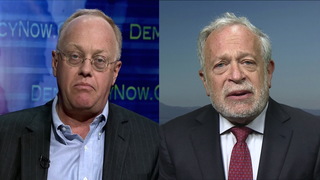
wins the presidential race, we host a debate between Clinton supporter
Robert Reich, who served as labor secretary under President Clinton, and
Chris Hedges, a Pulitzer Prize-winning journalist who backs Sanders.
TRANSCRIPT
This is a rush transcript. Copy may not be in its final form.
AMY GOODMAN: This is
Democracy Now!, democracynow.org. Our special, "Breaking with Convention: War, Peace and the Presidency." I’m Amy Goodman, with Juan González.
JUAN GONZÁLEZ: As we
continue to talk about the Democratic National Convention, we’re joined
now by two guests. Joining us from Berkeley, California, is Robert
Reich, who served as labor secretary under President Clinton and is a
professor at the University of California, Berkeley. And here in
Philadelphia is Chris Hedges, Pulitzer Prize-winning journalist. His
most recent book is
Wages of Rebellion: The Moral Imperative of Revolt.
And I’d like to begin with Robert Reich. You’re a—you were a Bernie
Sanders supporter. You’re now backing Hillary Clinton. You’re not at the
convention, but your perspective on what you saw last night and the
possibility of the Democratic Party uniting behind Hillary Clinton, or a
group of the Sanders supporters going with Jill Stein?
ROBERT REICH:
Well, it’s very hard to tell what the delegates are going to do. And
it’s very hard to tell—even harder to tell what the electorate is going
to do. You know, this is a very agonizing time for many Bernie Sanders
supporters. I, with a great deal of reluctance initially, because I’ve
known Hillary Clinton for 50 years—50 years—endorsed Bernie Sanders and
worked my heart out for him, as many, many people did. And so, at this
particular juncture, you know, there’s a great deal of sadness and a
great deal of feeling of regret. But having worked so long and so many
years for basically the progressive ideals that Bernie Sanders stands
for, I can tell you that the movement is going to continue. In fact,
it’s going to grow.
And right now, at this particular point in time, I just don’t see any
alternative but to support Hillary. I know Hillary, I know her faults, I
know her strengths. I think she will make a great president. I
supported Bernie Sanders because I thought he would make a better
president for the system we need. But nonetheless, Hillary Clinton is
going to be the nominee. I support her. And I support her not only
because she will be a good president, if not a great president, but
also, frankly, because I am tremendously worried about the alternative.
And the alternative, really, as a practical matter, is somebody who is a
megalomaniac and a bigot, somebody who will set back the progressive
movement decades, if not more.
AMY GOODMAN: Chris Hedges?
CHRIS HEDGES:
Well, reducing the election to personalities is kind of infantile at
this point. The fact is, we live in a system that Sheldon Wolin calls
inverted totalitarianism. It’s a system where corporate power has seized
all of the levers of control. There is no way to vote against the
interests of Goldman Sachs or ExxonMobil or Raytheon. We’ve lost our
privacy. We’ve seen, under Obama, an assault against civil liberties
that has outstripped what George W. Bush carried out. We’ve seen the
executive branch misinterpret the 2001 Authorization to Use Military
Force Act as giving itself the right to assassinate American citizens,
including children. I speak of Anwar al-Awlaki’s 16-year-old son. We
have bailed out the banks, pushed through programs of austerity. This
has been a bipartisan effort, because they’ve both been captured by
corporate power. We have undergone what John Ralston Saul correctly
calls a corporate coup d’état in slow motion, and it’s over.
I just came back from Poland, which is a kind of case study of how
neoliberal poison destroys a society and creates figures like Trump.
Poland has gone, I think we can argue, into a neofascism. First, it
dislocated the working class, deindustrialized the country. Then, in the
name of austerity, it destroyed public institutions, education, public
broadcasting. And then it poisoned the political system. And we are now
watching, in Poland, them create a 30,000 to 40,000 armed militia. You
know, they have an army. The Parliament, nothing works. And I think that
this political system in the United States has seized up in exactly the
same form.
So, is Trump a repugnant personality? Yes. Although I would argue
that in terms of megalomania and narcissism, Hillary Clinton is not far
behind. But the point is, we’ve got to break away from—which is exactly
the narrative they want us to focus on. We’ve got to break away from
political personalities and understand and examine and critique the
structures of power. And, in fact, the Democratic Party, especially
beginning under Bill Clinton, has carried water for corporate entities
as assiduously as the Republican Party. This is something that Ralph
Nader understood long before the rest of us, and stepped out very
courageously in 2000. And I think we will look back on that period and
find Ralph to be an amazingly prophetic figure. Nobody understands
corporate power better than Ralph. And I think now people have caught up
with Ralph.
And this is, of course, why I support Dr. Stein and the Green Party.
We have to remember that 10 years ago, Syriza, which controls the Greek
government, was polling at exactly the same spot that the Green Party is
polling now—about 4 percent. We’ve got to break out of this idea that
we can create systematic change within a particular election cycle.
We’ve got to be willing to step out into the political wilderness,
perhaps, for a decade. But on the issues of climate change, on the issue
of the destruction of civil liberties, including our right to
privacy—and I speak as a former investigative journalist, which doesn’t
exist anymore because of wholesale government surveillance—we have no
ability, except for hackers.
I mean, this whole debate over the WikiLeaks is insane. Did Russia?
I’ve printed classified material that was given to me by the Mossad. But
I never exposed that Mossad gave it to me. Is what was published true
or untrue? And the fact is, you know, in those long emails—you should
read them. They’re appalling, including calling Dr. Cornel West "trash."
It is—the whole—it exposes the way the system was rigged, within—I’m
talking about the Democratic Party—the denial of independents, the
superdelegates, the stealing of the caucus in Nevada, the huge amounts
of corporate money and super PACs that flowed into the Clinton campaign.
The fact is, Clinton has a track record, and it’s one that has
abandoned children. I mean, she and her husband destroyed welfare as we
know it, and 70 percent of the original recipients were children. This
debate over—I don’t like Trump, but Trump is not the phenomenon. Trump
is responding to a phenomenon created by neoliberalism. And we may get
rid of Trump, but we will get something even more vile, maybe Ted Cruz.
AMY GOODMAN: Robert Reich, I remember you, on
Democracy Now!,
talking about your time as labor secretary when President Clinton
signed off on welfare reform, and you described walking the streets of
Washington, D.C., wondering where the protests were, that you had
vigorously objected. And it was also an issue, a bill that Hillary
Clinton had supported. So, can you respond to Chris Hedges on these
three points, including, so, you take a walk in the political wilderness
for a little while?
ROBERT REICH:
Well, Amy, it’s not just taking a walk in the political wilderness. If
Donald Trump becomes president, if that’s what you’re referring to, I
think it is—there are irrevocable negative changes that will happen in
the United States, including appointments to the Supreme Court, that
will not be just political wilderness, that will actually change and
worsen the structure of this country. I couldn’t agree with Chris Hedges
more about his critique, overall, of neoliberalism and a lot of the
structural problems that we face in our political economy today. I’ve
written about them. But I’ve done more than write about them. I’ve
actually been in the center of power, and I have been doing everything I
possibly can, as an individual and also as a mobilizer and organizer of
others, to try to change what we now have.
I think that voting for Donald Trump or equating Hillary Clinton with
Donald Trump is insane. Donald Trump is certainly a product of a kind
of system and a systematic undermining that has occurred in the United
States for years with regard to inequality of income and wealth and
political power. But we don’t fight that by simply saying, "All right,
let’s just have Donald Trump and hope that the system improves itself
and hope that things are so bad that actually people rise up in armed
resistance." That’s insane. That’s crazy.
What we have to do is be—we’ve got to be very, very strategic as
progressives. We’ve got to look at the long term. We’ve got to
understand that Bernie Sanders brought us much further along than we
were before the Sanders campaign. We owe a lot to Bernie Sanders, his
courage, his integrity, his power, the fact that most people under 30
voted for Bernie Sanders. In fact, if you look at the people who voted
for Bernie Sanders under 30, that was more people than voted for Donald
Trump and Hillary Clinton together under the age of 30. We are building a
progressive movement in this country. But over the next four years, I
don’t want Donald Trump to irretrievably make it difficult, if not
impossible, for us to move forward with that progressive movement.
Now, I understand Hillary Clinton is not perfect. I’ve known her , as
I said before, for 50 years. I met her when she was 19 years old. I
know her strengths, and I know, pretty well, her weaknesses. She is not
perfect. And as Chris says, you know, she is also very much a product of
many of the problems structurally in this country right now. We fight
those structural problems, yes. Hand in hand, Chris, with you, shoulder
to shoulder—I’m very short, maybe it’s my shoulder, and it’s your rib
cage—but it doesn’t matter, we continue to fight. I will continue to
fight. Many people who are watching and listening will continue to
fight. We must continue to mobilize. I hope Bernie Sanders does what he
implied he would do last night—that is, carry the movement forward, lend
his name, his energy, his email list. This is not the end of anything.
But we have got to be, at the same time, very practical about what we’re
doing and very strategic about what we’re doing. This is not just a
matter of making statements. It’s a matter of actually working with and
through, and changing the structure of power in this country.
JUAN GONZÁLEZ: Chris, I’d
like to ask you—you’ve written that liberals are tolerated by the
capitalist elites because they do not question the virtues of corporate
capitalism, only its excesses, and call for tepid and ineffectual
reforms. Could that have also have been said of
FDR in the 1930s? Because you were one of the folks who did not back Bernie Sanders from the beginning.
CHRIS HEDGES: That’s right.
JUAN GONZÁLEZ: So, you’ve—
CHRIS HEDGES:
Well, I didn’t back Bernie Sanders because—and Kshama Sawant and I had
had a discussion with him before—because he said that he would work
within the Democratic structures and support the nominee. And I think we
have now watched Bernie Sanders walk away from his political moment.
You know, he—I think he will come to deeply regret what he has done. He
has betrayed these people who believed in this political revolution. We
heard this same kind of rhetoric, by the way, in 2008 around Obama.
A political campaign raises consciousness, but it’s not a movement.
And what we are seeing now is furious spin—I listened to Ben Jealous
just do it—from the self-identified liberal class. And they are
tolerated within a capitalist system, because, in a moment like this,
they are used to speak to people to get them to betray their own
interests in the name of fear. And I admire Robert and have read much of
his stuff and like his stuff, but if you listen to what he’s been
saying, the message is the same message of the Trump campaign, and that
his fear. And that is all the Democrats have to offer now and all the
Republicans have to offer now.
And the fact is, from climate change alone, we have no time left. I
have four children. The future of my children, by the day, is being
destroyed because of the fact that the fossil fuel industry, along with
the animal agriculture industry, which is also as important in terms of
climate change, are destroying the ecosystem on which we depend for
life. And neither party has any intention to do anything about it.
AMY GOODMAN: What should Bernie Sanders have done?
CHRIS HEDGES: Bernie Sanders should have walked out and run as an independent.
AMY GOODMAN: Take—
CHRIS HEDGES: And defied the Democratic Party.
AMY GOODMAN: Take up the invitation of Dr. Jill Stein—
CHRIS HEDGES: Yes.
AMY GOODMAN: —and run on a ticket with—
CHRIS HEDGES:
She offered to let him run on the top of the ticket. That’s what he
should have done. And the fact is, you know, let’s not forget that
Bernie has a very checkered past. He campaigned for Clinton in '92. He
campaigned for Clinton again in ’96, after NAFTA—the greatest betrayal
of the working class in this country since the Taft-Hartley Act of
1948—after the destruction of welfare, after the omnibus crime bill that
exploded the prison population, and, you know, we now have—I mean, it's
just a monstrosity what we’ve done; 350,000 to 400,000 people locked in
cages in this country are severely mentally ill. Half of them never
committed a violent crime. That’s all Bill Clinton. And yet he went out
and campaigned. In 2004, he called on Nader not to run, to step down, so
he could support a war candidate like John Kerry. And I’m listening to
Jealous before talk about the Iraq War. Sixty percent of the Democratic
senators voted for the war, including Hillary Clinton. The idea that
somehow Democrats don’t push us into war defies American history.
AMY GOODMAN: Robert Reich?
ROBERT REICH:
Well, all I can say is that at this particular point in time—I mean,
again, many of the things that Chris Hedges is saying, I completely
agree with. The real question here is: What do we do right now? And what
do we do to mobilize and organize a lot of people out there who right
now are not mobilized and organized? And how do we keep the energy
building? I disagree with Chris with regard to Bernie Sanders. I think
Bernie Sanders has been a great and is a great leader right now of the
progressive cause.
What I think we ought to do is develop a third party outside the
Democratic and Republican parties, maybe the Green Party, so that in the
year 2020, four years from now, we have another candidate—it may be
Bernie Sanders, I think he’s probably going to be too old by then—but we
have a candidate that holds the Democrats accountable, that provides a
vehicle for a lot of the energy of the Bernie Sanders movement to
continue to develop, that fields new candidates at the Senate, in
Congress, at the state level, that actually holds Democrats’ feet to the
fire and Republicans’ feet to the fire, that develops an agenda of
getting big money out of politics and severing the link between
extraordinarily concentrated wealth and political power in this country.
That’s what we ought to be doing.
Now, we can—but in order to do that, we cannot have—and, you know, I
think that Hillary will be a good president, if not a great president.
This is not just trucking in fear, Chris. But I do fear Donald Trump. I
fear the polls that I saw yesterday. Now, polls, again, this early in a
campaign still—we’re still months away from the election, but they are
indicative. They show Donald Trump doing exceedingly well, beating
Hillary Clinton. And right now, given our two-party system, given our
winner-take-all system with regard to the Electoral College, it’s just
too much of a risk to go and to say, "Well, I’m going to vote—I’m not
going to vote for the lesser of two evils, I’m going to vote exactly
what I want to do." Well, anybody can do that, obviously. This is a free
country. You vote what you—you vote your conscience. You have to do
that. I’m just saying that your conscience needs to be aware that if you
do not support Hillary Clinton, you are increasing the odds of a true,
clear and present danger to the United States, a menace to the United
States. And you’re increasing the possibility that there will not be a
progressive movement, there will not be anything we believe in in the
future, because the United States will really be changed for the worse.
That’s not a—that’s not a risk I’m prepared to take at this point in
time. I’m going to move—I’m going to do exactly what I’ve been doing for
the last 40 years: I’m going to continue to beat my head against the
wall, to build and contribute to building a progressive movement. The
day after Election Day, I am going to try to work with Bernie Sanders
and anybody else who wants to work in strengthening a third party—and
again, maybe it’s the Green Party—for the year 2020, and do everything
else I was just talking about. But right now, as we lead up to Election
Day 2016, I must urge everyone who is listening or who is watching to do
whatever they can to make sure that Hillary Clinton is the next
president, and not Donald Trump.
AMY GOODMAN:
Well, we’re going to break and then come back to this debate on both
sides of the United States, as well as of this issue. Chris Hedges is
with us, Pulitzer Prize-winning journalist, award-winning author and
activist. Latest book,
Wages of Rebellion: The Moral Imperative of Revolt.
And who you were just listening to is Robert Reich, who is the former
labor secretary under President Clinton and professor at University of
California, Berkeley, his latest book called
Saving Capitalism.
He was a Bernie Sanders supporter and now says he will vote for Hillary
Clinton. When we come back, we’ll hear some of the words of Donald
Trump and get response. Stay with us.
[break]
AMY GOODMAN: "Opening Ceremony" by Laura Ortman. This is
Democracy Now!,
democracynow.org. Our special for this two weeks, "Breaking with
Convention: War, Peace and the Presidency." I’m Amy Goodman, with Juan
González.
JUAN GONZÁLEZ: Well, in a
moment, we’ll return to our debate between Robert Reich and Chris
Hedges, but first let’s turn to Donald Trump’s nomination speech at the
RNC in Cleveland last Thursday. Trump said Sanders’ supporters would vote for him in the fall.
DONALD TRUMP:
I have seen firsthand how the system is rigged against our citizens,
just like it was rigged against Bernie Sanders. He never had a chance,
never had a chance. But his supporters will join our movement, because
we will fix his biggest single issue—trade deals that strip our country
of its jobs and strip us of our wealth as a country. Millions of
Democrats will join our movement, because we are going to fix the system
so it works fairly and justly for each and every American.
JUAN GONZÁLEZ: That was
Donald Trump talking at the convention in Cleveland. Robert Reich,
interestingly, Donald Trump and Chris Hedges agree on one thing, that
free trade deals that the—that both the Republicans and Democrats have
negotiated over the past few years, especially
NAFTA, have been disastrous for the American people. You were part of the Clinton administration when
NAFTA was passed. Talk about this, the impact that Trump is utilizing among white workers in America over the issue of free trade.
ROBERT REICH:
Well, Donald Trump is clearly using trade and also immigration as
vehicles for making the people who have really been hurt by trade, by
globalization, feel that he is going to somehow be on their side. He’s
not going to be on their side.
Trump is right in a very, very narrow respect, that trade has hurt
very vulnerable people, working-class people. The burdens of trade have
been disproportionately fallen on those people who used to have good
unionized jobs in America. And the failure of
NAFTA and also the
WTO, the World Trade Organization, Chinese ascension into the
WTO,
all of those Clinton-era programs—the failure was, number one, not to
have nearly strong enough and enforceable enough labor and environmental
side agreements; number two, not to have adjustment mechanisms here in
the United States for people who lost their jobs to help them get good
jobs, that were new jobs, for the jobs they lost. The winners in trade
could have compensated the losers and still come out ahead, but they did
not. And that is a structural, political problem in this country that
we have to address.
It is also a problem with regard to technological displacement. It’s
not just trade. Technology is displacing and will continue to displace
and will displace even more good jobs in the future, but we have
absolutely no strategy for dealing with that. And right now, the burdens
of technological displacement are falling, once again, on the working
middle class, lower-income people, who have very, very few alternatives,
driving a greater and greater wedge between those who are lucky enough
to be—to have rich parents or be well educated or be well connected, and
everybody else.
We cannot go on like this. This is unsustainable. And Donald Trump
and Bernie Sanders are symptomatic, their rise, are both symptomatic of
this great wave of antiestablishment anger that is flooding American
politics, although on the one side you have authoritarian populism, and
on the Bernie Sanders side you have a political revolution. I prefer the
political revolution myself. I’m going to continue to work for that
political revolution.
CHRIS HEDGES:
Well, I think we have to acknowledge two facts. We do not live in a
functioning democracy, and we have to stop pretending that we do. You
can’t talk about—when you eviscerate privacy, you can’t use the word
"liberty." That is the relationship between a master and a slave. The
fact is, this is capitalism run amok. This whole discussion should be
about capitalism. Capitalism does what it’s designed to do, when it’s
unfettered or unregulated—as it is—and that is to increase profit and
reduce the cost of labor. And it has done that by deindustrializing the
country, and the Clinton administration, you know, massively enabled
this.
And, you know, we’re sitting here in Philadelphia. The last
convention was in Cleveland. These are Potemkin villages, where the
downtowns are Disneyfied, and three and four blocks away people are
living in appalling poverty. We have responded to surplus labor, as Karl
Marx says, in our deindustrialized internal colonies, to quote Malcolm
X, by putting poor people of color in cages all across the country. Why?
It’s because surplus labor—corporate entities cannot make money off of
surplus or redundant labor. But when you lock them in a cage, they make
$40,000 or $50,000 a year. This is the system we live in.
We live in a system where, under Section 1021 of the National Defense
Authorization Act, the executive branch can put the soldiers in the
streets, in clear violation of the 1878 Posse Comitatus Act, to
see—carry out extraordinary rendition of American citizens who are
deemed to be, quote-unquote, "terrorists," strip them of due process and
hold them indefinitely in military facilities, including in our black
sites. We are a country that engages in torture.
We talk—Robert talks about, you know, building movements. You can’t
build movements in a political system where money has replaced the vote.
It’s impossible. And the Democrats, you know, their bedside manner is
different from the Republicans. You know, Trump is this kind of
grotesque figure. He’s like the used car salesman who rolls back the
speedometer. But Hillary Clinton is like, you know, the managers of
Goldman Sachs. They both engage in criminal activities that have—and
Clinton’s record, like Trump, exposes this—that have preyed upon the
most vulnerable within this country and are now destroying the middle
class. And to somehow speak as if we are in a functioning democracy, or
speak as if there are any restraints on capitalism, or speak as if the
Democratic Party has not pushed forward this agenda—I mean, Obama has
done this. You know, he has been as obsequious to Wall Street as the
Bush administration. There’s no difference.
AMY GOODMAN: Robert Reich?
ROBERT REICH:
Chris, you know, I—again, I find this a frustrating conversation,
because I agree with so much of what you have said, but the question is:
What do we do about it? I mean, we are in a better position today, in
the sense that Bernie Sanders has helped mobilize, organize and energize
a lot of Americans, and educated a lot of Americans about the very
issues that you have talked and written about and I have talked and
written about. But it is—the question is: What is the action? What is
the actual political strategy right now?
CHRIS HEDGES: Well, let me—let me answer that.
ROBERT REICH: And I think the political—
CHRIS HEDGES: Let me answer that.
ROBERT REICH:
Well, let me just—let me just put in my two cents. I think political
strategy is not to elect Donald Trump, to elect Hillary Clinton, and,
for four years, to develop an alternative, another Bernie Sanders-type
candidate with an independent party, outside the Democratic Party, that
will take on Hillary Clinton, assuming that she is elected and that she
runs for re-election, and that also develops the infrastructure of a
third party that is a true, new progressive party.
CHRIS HEDGES:
Well, that’s precisely what we’re trying to do. There is a point where
you have to—do I want to keep quoting Ralph?—but where you have to draw a
line in the sand. And that’s part of the problem with the left, is we
haven’t.
I covered the war in Yugoslavia, and I find many parallels between
what’s happening in the United States and what happened with the
breakdown of Yugoslavia. What is it that caused this country to
disintegrate? It wasn’t ancient ethnic hatreds. It was the economic
meltdown of Yugoslavia and a bankrupt liberal establishment that, after
the death of Tito, until 1989 or 1990, spoke in the language of
democracy, but proved ineffectual in terms of dealing with the plight of
working men and women who were cast out of state factories, huge
unemployment and, finally, hyperinflation.
And the fact is that these neoliberal policies, which the Democratic
Party is one of the engines for, have created this right-wing
fascialism. You can go back—this proto-fascism. You can go back and look
at the Weimar, and it—Republic—was very much the same. So it’s
completely counterintuitive. Of course I find Trump a vile and
disturbing and disgusting figure, but I don’t believe that voting for
the Democratic establishment—and remember that this—the two
insurgencies, both within the Republican Party and the—were against
figures like Hillary Clinton, who spoke in that traditional
feel-your-pain language of liberalism, while assiduously serving
corporate power and selling out working men and women. And they see
through the con, they see through the game.
I don’t actually think Bernie Sanders educated the public. In fact,
Bernie Sanders spoke for the first time as a political candidate about
the reality the public was experiencing, because even Barack Obama, in
his State of the Union address, was talking about economic recovery, and
everything was wonderful, and people know that it’s not. And when you
dispossess—
ROBERT REICH: Well, let me—let me—
CHRIS HEDGES:
Let me just finish. Let me finish. When you dispossess that segment, as
large as we have—half the country now lives in virtual poverty—and you
continue to essentially run a government that’s been seized by a cabal,
in this case, corporate, which uses all of the machinery of government
for their own enrichment and their own further empowerment at the
expense of the rest of the citizenry, people finally react. And that is
how you get fascism. That is what history has told us. And to sit
by—every time, Robert, you speak, you do exactly what Trump does, which
is fear, fear, fear, fear, fear. And the fact that we are going to build
some kind of—
ROBERT REICH: Well, let me—let me try to—
CHRIS HEDGES: —amorphous movement after Hillary Clinton—it’s just not they way it works.
ROBERT REICH: Let me try to inject—let me—let me try to inject—
AMY GOODMAN: Former Clinton Labor Secretary Robert Reich?
ROBERT REICH:
Let me try to inject some hope in here, in this discussion, rather than
fear. I’ve been traveling around the country for the last two years,
trying to talk to tea partiers and conservatives and many people who are
probably going to vote for Donald Trump, to try to understand what it
is that they are doing and how they view America and why they’re acting
in ways that are so obviously against their self-interest, both economic
self-interest and other self-interest. And here’s the interesting thing
I found.
This great antiestablishment wave that is occurring both on the left
and the right has a great overlap, if you will, and that overlap is a
deep contempt for what many people on the right are calling crony
capitalism—in fact, many people on the left have called crony
capitalism. And those people on the right, many, many working people,
they’re not all white. Many of them are. Many of them are working-class.
Many of them have suffered from trade and technological displacement
and a government that is really turning its back on them, they feel—and
to some extent, they’re right. Many of them feel as angry about the
current system and about corporate welfare and about big money in
politics as many of us on the progressive side do.
Now, if it is possible to have a multiracial, multiethnic coalition
of the bottom 90 percent that is ready to fight to get big money out of
politics, for more equality, for a system that is not rigged against
average working people, where there are not going to be all of these
redistributions upward from those of us who have paychecks—and we don’t
even realize that larger and larger portions of those paychecks are
going to big industries, conglomerates, concentrated industries that
have great market power, because it’s all hidden from view—well, the
more coalition building we can do, from right to left, multiethnic,
multiracial, left and right, to build a movement to take back our
economy and to take back our democracy, that is—
JUAN GONZÁLEZ: Robert
Reich—Robert Reich, I’d just like to interrupt you for a second, because
we only have a minute left, and I just wanted to ask Chris one last
question. In less than a minute, if you can, regardless of—you’re voting
for Jill Stein, other folks are going to vote for Clinton and Trump.
Where do you feel this massive movement that has developed over the last
few years, this people movement, would have a better opportunity to
grow, under a Trump presidency or under a Clinton presidency, assuming
that one of those two will eventually be elected?
CHRIS HEDGES: I don’t think it makes any difference. The
TPP
is going to go through, whether it’s Donald Trump or Hillary Clinton.
Endless war is going to be continued, whether it’s Trump or Clinton.
We’re not going to get our privacy back, whether it’s under Clinton or
Trump. The idea that, at this point, the figure in the executive branch
exercises that much power, given the power of the war industry and Wall
Street, is a myth. The fact is—
ROBERT REICH: Equating—I’m sorry. I’m sorry.
JUAN GONZÁLEZ: Even on immigration?
CHRIS HEDGES: What? On?
JUAN GONZÁLEZ: Even on immigration?
CHRIS HEDGES: What? On immigration? I mean, let’s look at Obama’s record on immigration. Who’s worse?
AMY GOODMAN: We’ve got 10 seconds.
CHRIS HEDGES: I mean, you know, you can’t get worse than Obama.
ROBERT REICH: And can I just say something?
CHRIS HEDGES: I mean, the idea is, the Democrats speak, and the—
AMY GOODMAN: Robert Reich, 10 seconds.
CHRIS HEDGES: Yeah.
ROBERT REICH:
I just want to say, equating Donald Trump and Hillary Clinton is
absolute nonsense. I just—anybody who equates the two of them is not
paying attention. And it’s dangerous kind of talk.
CHRIS HEDGES: That’s not what I—that’s not what I did.
AMY GOODMAN:
We’re going to have to leave it there, but this is a discussion that
will continue. Chris Hedges, I want to thank you for being with us,
Pulitzer Prize-winning journalist, author of
Wages of Rebellion: The Moral Imperative of Revolt.
And former Clinton Labor Secretary Robert Reich, professor now at the
University of California, Berkeley. His most recent book,
Saving Capitalism.
That does it for the broadcast. I’ll be in
Provincetown, Massachusetts and
Martha’s Vineyard this weekend, doing a talk back from the conventions.
Special thanks to Laura Deutch, Gretjen Clausing, Ryan Saunders and the whole team here at PhillyCAM.