Criptic Critic Conscience and Known for it
Thursday, February 7, 2013
%5 forced unemployment, fakes job competition, stops wages rising, Gov, uses forced poverty to controls inflation.
Stable Economy by Permanent Poverty. The N.A.I.R.U and the New Zealand Economy
Introduction
I am interested in exploring poverty in New Zealand and its intimate connection to wage rates, unemployment and inflation. Over the last thirty years in New Zealand we have undergone transformative reforms in the economic and welfare sectors. The effect has created a significant increase in the gap between rich and poor, to where today ours is one of the largest in the world (Donaldson & Hubbard, 2011), suggesting that we don’t have welfare in New Zealand, but well-orchestrated poverty.
Themes:
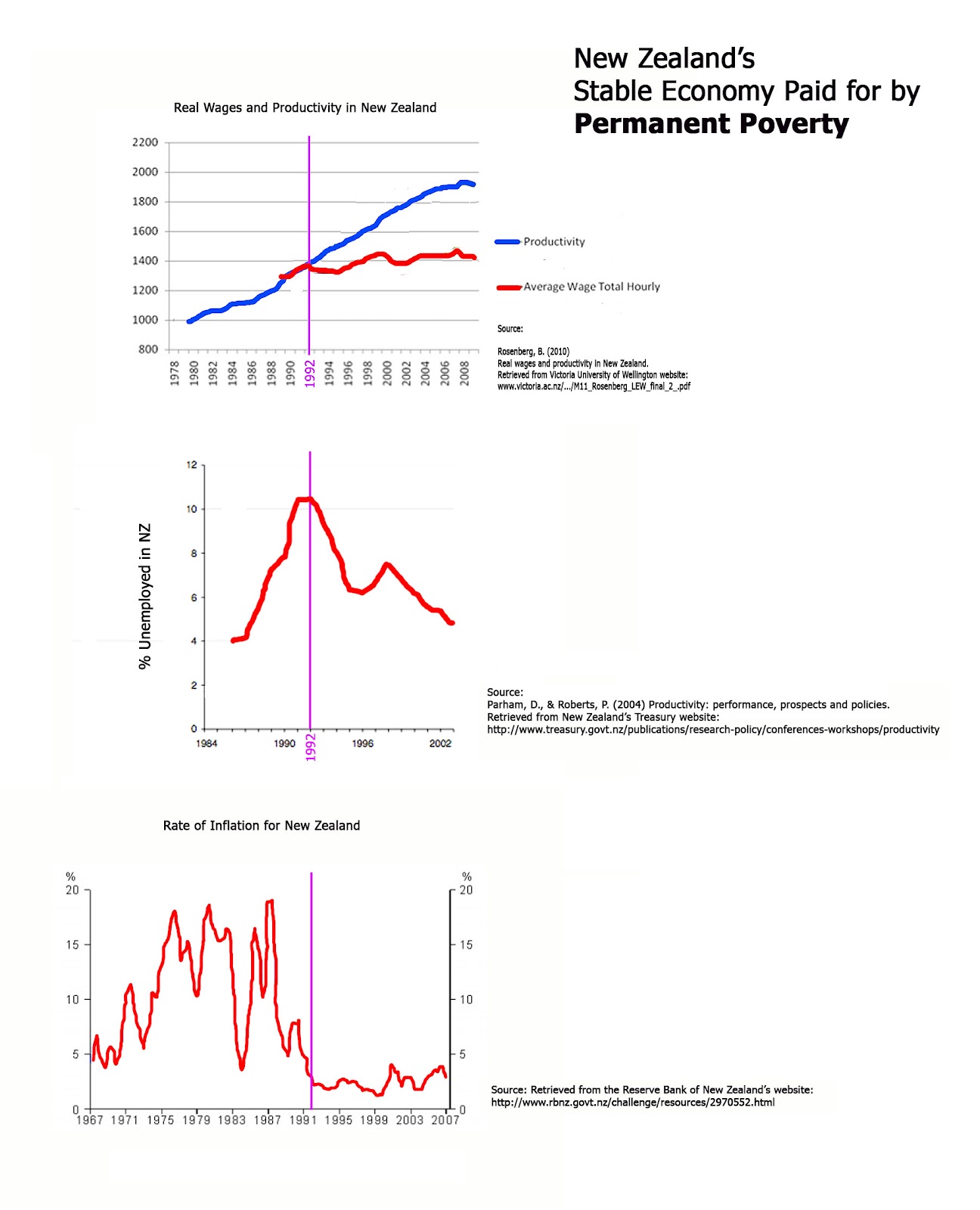
According to Bill Rosenberg, Economist and Director of Policy at the New Zealand Council of Trade Unions [CTU], wages rose on average according to the rate of productivity up until 1992. However, after 1992, productivity continued to rise at a steady rate, and wages on average did not (Rosenberg, 2010). If we look at data on the New Zealand Treasury website which shows us unemployment rates since 1986, we can see in 1992 the largest spike in unemployment in New Zealand history, with almost eleven percent of the population registered as unemployed (Parham & Roberts, 2004).
Could these two sets of data be related? According to Alister Barry in his documentary, In a Land of Plenty, they clearly are; “the reserve bank would manipulate interest rates so that at any given time one hundred to one hundred and fifty thousand kiwis would be unemployed....more unemployed people competing for jobs was bound to drive wages down” (Barry, 2002). A precedent was set that was then to become the norm.
But why would the government want New Zealanders to have a low wage? It is one way to control inflation, and maintain great wealth for the few (Barry). This is clearly demonstrated by the Non Accelerating Inflation Rate of Unemployment [NAIRU], which defines the lowest level of unemployment an economy can handle without causing rising inflation (Wikipedia.org, n.d.). New Zealand’s NAIRU is currently estimated to be five percent (Johnston, 2011), our current unemployment rate is 6.8% (Trading Economics, n.d.), and correspondingly our inflation is very low (Trading Economics). When unemployment was high in 1992, inflation dropped to its second lowest in New Zealand’s economic history (Trading Economics), thanks to the unemployed.
Current concern:
Right now New Zealanders have a new round of welfare reforms being implemented that continue the agenda set 1991. According to The New Zealand Herald, “anyone who turns down any offer of ‘suitable employment’ will have their benefit cancelled” (Collins, 2012). This is seen as a logical escalation of what was in place before; whereby the client was given “three chances” before they were cut. This reform continues to undermine the basic right of choice for a New Zealand citizen, as the Work and Income New Zealand [WINZ] case manager decides what is ‘suitable’ for the client.
Personal impact:
I was affected directly by the above scenario in 2010 as a person with part time employment (see www.wellsgroup.org) looking for full time work and receiving an unemployment benefit. After consultation with the Ministry of Social Development’s work brokers, where we discussed which were suitable and unsuitable jobs, I was immediately offered employment in the very role that I had identified as unsuitable due to my physical and mental health at the time. Despite there being many suitable jobs that I had expressed a direct enthusiasm for, I had no actual choice. Job ‘suitability’ was simply being used as a means to remove myself from their support. At the time I considered mine an isolated incident but having since worked alongside benefit rights advocates and meeting other cases, I understand this is an accepted procedure.
Conclusion:
In short I had refused to participate in what is now the very essence of welfare; a tool for applying pressure on existing jobs by falsely creating the impression that there are numerous able applicants available for a position. That pressure of course is applied using real people living on the margins of society in poverty. People growing more and more desperate and becoming increasingly prepared to accept lower and lower standards of living. This is the accepted way to manage the economy and control inflation. As Suzanne Snively of the Reserve Bank Board of Directors from 1985-92 has said: “...it was a manageable thing for the reserve bank to use employment and unemployment as a means to get wages down, it was far easier than any other means to get inflation down, so they used it” (Barry).
References:
Barry, A. (2002) In a land of plenty clip. [Videofile] Retrieved from http://www.youtube.com/watch?v=DcWl1rSVnYU
Collins, S. (2012). ‘One strike’ rule for beneficiaries. Retrieved from The New Zealand Herald website: http://www.nzherald.co.nz/politics/news/article.cfm?c_id=280&objectid=10834762
Donaldson, M., & Hubbard, A. (2011) Wealth gap divides nation. Retrieved from http://www.stuff.co.nz/national/4571384/Wealth-gap-divides-nation
Johnston, M. (2011) New Zealand’s NAIRU and youth unemployment. Retrieved from Econfix: http://econfix.wordpress.com/2011/07/06/new-zealands-nairu-and-youth-unemployment/
Parham, D., & Roberts, P. (2004) Productivity: performance, prospects and policies. Retrieved from New Zealand’s Treasury website: http://www.treasury.govt.nz/publications/research-policy/conferences-workshops/productivity
Rosenberg, B. (2010) Real wages and productivity in New Zealand. Retrieved from Victoria University of Wellington website: www.victoria.ac.nz/.../M11_Rosenberg_LEW_final_2_.pdf
Trading Economics. (n.d.). New Zealand unemployment rate. Retrieved from http://www.tradingeconomics.com/new-zealand/unemployment-rate
-->
Wikipedia.org. (n.d). NAIRU. Retrieved from: http://en.wikipedia.org/wiki/Nairu
Friday, February 1, 2013
The real invasion of Africa is not news and a licence to lie is Hollywood's gift
John Pilger
31 January 2013
A full-scale invasion of Africa is under way. The United States is deploying troops in 35 African countries, beginning with Libya, Sudan, Algeria and Niger. Reported by Associated Press on Christmas Day, this was missing from most Anglo-American media.
The invasion has almost nothing to do with "Islamism", and almost everything to do with the acquisition of resources, notably minerals, and an accelerating rivalry with China. Unlike China, the US and its allies are prepared to use a degree of violence demonstrated in Iraq, Afghanistan, Pakistan, Yemen and Palestine. As in the cold war, a division of labour requires that western journalism and popular culture provide the cover of a holy war against a "menacing arc" of Islamic extremism, no different from the bogus "red menace" of a worldwide communist conspiracy.
Reminiscent of the Scramble for Africa in the late 19th century, the US African Command (Africom) has built a network of supplicants among collaborative African regimes eager for American bribes and armaments. Last year, Africom staged Operation African Endeavor, with the armed forces of 34 African nations taking part, commanded by the US military. Africom's "soldier to soldier" doctrine embeds US officers at every level of command from general to warrant officer. Only pith helmets are missing.
It is as if Africa's proud history of liberation, from Patrice Lumumba to Nelson Mandela, is consigned to oblivion by a new master's black colonial elite whose "historic mission", warned Frantz Fanon half a century ago, is the promotion of "a capitalism rampant though camouflaged".
A striking example is the eastern Congo, a treasure trove of strategic minerals, controlled by an atrocious rebel group known as the M23, which in turn is run by Uganda and Rwanda, the proxies of Washington.
Long planned as a "mission" for Nato, not to mention the ever-zealous French, whose colonial lost causes remain on permanent standby, the war on Africa became urgent in 2011 when the Arab world appeared to be liberating itself from the Mubaraks and other clients of Washington and Europe. The hysteria this caused in imperial capitals cannot be exaggerated. Nato bombers were dispatched not to Tunis or Cairo but Libya, where Muammar Gaddafi ruled over Africa's largest oil reserves. With the Libyan city of Sirte reduced to rubble, the British SAS directed the "rebel" militias in what has since been exposed as a racist bloodbath.
The indigenous people of the Sahara, the Tuareg, whose Berber fighters Gaddafi had protected, fled home across Algeria to Mali, where the Tuareg have been claiming a separate state since the 1960s. As the ever watchful Patrick Cockburn points out, it is this local dispute, not al-Qaida, that the West fears most in northwest Africa... "poor though the Tuareg may be, they are often living on top of great reserves of oil, gas, uranium and other valuable minerals".
Almost certainly the consequence of a French/US attack on Mali on 13 January, a siege at a gas complex in Algeria ended bloodily, inspiring a 9/11 moment in David Cameron. The former Carlton TV PR man raged about a "global threat" requiring "decades" of western violence. He meant implantation of the west's business plan for Africa, together with the rape of multi-ethnic Syria and the conquest of independent Iran.
Cameron has now ordered British troops to Mali, and sent an RAF drone, while his verbose military chief, General Sir David Richards, has addressed "a very clear message to jihadists worldwide: don't dangle and tangle with us. We will deal with it robustly" - exactly what jihadists want to hear. The trail of blood of British army terror victims, all Muslims, their "systemic" torture cases currently heading to court, add necessary irony to the general's words. I once experienced Sir David's "robust" ways when I asked him if he had read the courageous Afghan feminist Malalai Joya's description of the barbaric behaviour of westerners and their clients in her country. "You are an apologist for the Taliban" was his reply. (He later apologised).
These bleak comedians are straight out of Evelyn Waugh and allow us to feel the bracing breeze of history and hypocrisy. The "Islamic terrorism" that is their excuse for the enduring theft of Africa's riches was all but invented by them. There is no longer any excuse to swallow the BBC/CNN line and not know the truth. Read Mark Curtis's Secret Affairs: Britain's Collusion with Radical Islam (Serpent's Tail) or John Cooley's Unholy Wars: Afghanistan, America and International Terrorism (Pluto Press) or The Grand Chessboard by Zbigniew Brzezinski (HarperCollins) who was midwife to the birth of modern fundamentalist terror. In effect, the mujahedin of al-Qaida and the Taliban were created by the CIA, its Pakistani equivalent, the Inter-Services Intelligence, and Britain's MI6.
Brzezinski, President Jimmy Carter's National Security Adviser, describes a secret presidential directive in 1979 that began what became the current "war on terror". For 17 years, the US deliberately cultivated, bank-rolled, armed and brainwashed jihadi extremists that "steeped a generation in violence". Code-named Operation Cyclone, this was the "great game" to bring down the Soviet Union but brought down the Twin Towers.
Since then, the news that intelligent, educated people both dispense and ingest has become a kind of Disney journalism, fortified, as ever, by Hollywood's licence to lie, and lie. There is the coming Dreamworks movie on WikiLeaks, a fabrication inspired by a book of perfidious title-tattle by two enriched Guardian journalists; and there is Zero Dark Thirty, which promotes torture and murder, directed by the Oscar-winning Kathryn Bigelow, the Leni Riefenstahl of our time, promoting her master's voice as did the Fuhrer's pet film-maker. Such is the one-way mirror through which we barely glimpse what power does in our name.
Wednesday, January 30, 2013
Tuesday, January 29, 2013
The World Could Be Anything (July, 1990) ~ Terence McKenna
"At this point you are probably very concerned about your mental condition, and if you aren't your friends are, because what you're saying at this point is, the rivers talk to me, the trees whisper in my ear. What you're recovering is the meaning, that's all, the meaning that is self evident in nature but that we block. The meaning is so pregnant in everything that it can actually articulate itself in your native English tongue and talking rocks talking trees talking boulders, we define this as pathology, it means in technical jargon, a severely diminished ego is in danger of overwhelmment by material from the inchoate and disorganized unconscious, well but what is actually happening is that for the first time in somebodies life or experience they are meeting the resident meaning in reality with it's force unblunted by conditioning and denial.This is some kind of linguistic process we and all nature swims in some kind of sea of signification of which we are in the same way that the amphibians were able to drag themselves out of the primitive oceans of this planet into air and exist in a completely different dimension, we whether grandly or perversely the verdict is not yet in, we dragged our selves out of the sea of telepathic interconnected signification that united all life and we exist, panting and pop eyed in this other dimension called history."
Sunday, January 27, 2013
Thursday, January 24, 2013
Tuesday, January 22, 2013
Sunday, January 20, 2013
Wellywood Woman: They might have completely forgotten us
Wellywood Woman: They might have completely forgotten us:
- You like this.
- Wells Tao " The Wellington Media Collective will be remembered for its contribution to three major success stories of New Zealand political activism: the anti-Apartheid movement, notably opposition to the 1981 Springbok Tour; the campaign against nuclear testing in the Pacific; and the Maori Rights movement and Maori Renaissance following the establishment of the Waitangi Tribunal in 1981.
I gasped. Surrounded by artefacts from the women's movement, I couldn't believe what I read. Was the women's movement in all its diversity not 'a major success story'? Or had the curators of the exhibition not looked carefully at the content of the posters and the list of organisations that the Media Collective worked with? Did they not know about – for instance – Robyn Kahukiwa's and Debra Bustin's connections to the women's art movement through the Women's Gallery, and in Robyn's case through Haeata, primarily part of the Te Puawaitanga?" - Wells Tao "No artists' names attributed to the Women's Gallery posters. (Mechanism: Belittling carelessness with women's work – the date of publication easily established online and the posters' makers readily established through straightforward research at the Turnbull Library or by making a couple of phone calls.) The label for Women Under Capitalism, which referred to its exhibition 'at an event put on by a women's trade union group' – what group? It wouldn't have been hard to find out its name. (Mechanism: Ignoring us.) And the complete absence of posters from at least one outstanding woman poster-maker who often chose to be anonymous. (Mechanism: Ignoring us.) I went home and DM'd her. Has she seen the show? Was I overreacting? She messaged back –Yes I felt a bit peeved that [our groups] didn't get a mention, but it was quite a select group of people, not that the other women weren't feminists. I think they might have completely forgotten that we used their resources..."
Thursday, January 17, 2013
Monday, January 14, 2013
The Face of Panic: The Face of Panic Episode SevenDownload a free h...
The Face of Panic: The Face of Panic Episode Seven
Download a free h...: The Face of Panic Episode Seven Download a free high quality version HERE Track list Will Gresson + Luke Munn Six forty-seven ...
Saturday, December 22, 2012
Friday, December 21, 2012
Thursday, December 20, 2012
Subscribe to:
Posts (Atom)