Saturday, October 27, 2012

Friday, October 26, 2012
Code is code, Life can be defined digitaly. Financial program as spinal cord of life. Oranizational apetites create tension, not between space and time, but between information (code that fits established spinal cord) and nonsense. A super intelligence A.I, decesions made entirely by machines capable of appreciating the drama of the decision. The human real operates at 100hz, a 1000hz machine is operating at a million times faster, we will not have the luxury of watching machines establishing their civilization on the beach head, the very notion of ultra intelligence will be beyond recognition. What will this child of ours make of us when we are the child to their adult
Monday, October 22, 2012


Thursday, October 18, 2012
amateur internet porn films of surveillance of people fucking like animals right at the heart of the industrial military complex the core of fear fed, The divinity of cock and cunt and arsehole, and mouth and mouth and armhole, and cunt and cock. the horny hairy boobs, of the politically oppressed, the stay at home dreamers those that breed live in their dreams full of fantasy fed into the one body or the bodies at most close to hand as the mind will allow the beauty being paramount the choice is kept a particularly clean The super ram of java tits the pound flesh bragade of red battalions pounding pussy on parade poking corn holes rapidly popping the facade Wives, with berate fed tits long and plump with nipples to chew on pink and harry with a dewy matt of grass this wondercow eats my sperm. THe other night, in other I shot my seed of life, into the edge of her hole that consumes things and transforms them into something else. Woman of death, the unveiled, the only graduation. Death her who knows dwells well, wive home movies we are going to create a series of paintings that are on my cock, and take in erections so filmed as well as photographed. the sado machoism of being used for sex and surveying euphorically with an outer body inner body mystique experience of hare core experiential qualities, and greet literary back grounds with the boundary disolvers, the beat the psychedelics the hippy hardcovers, where ever they are. the mutual transference, the swapping of roles, the given as a state of change absorbed and said back to each other agina as if you knew what the other was going to say next and in knowing so knowing it is exactly your line when you play her, or him that you are allowed to be freed to be let go of hainvg to be your self in that form but are free to transcend langagues dcihotomy itls stuck duality and purge froth into the 3rd dimension, just briefly for a look around, and make a brief assessment of what the written brain has done.. to where we live, god damed that one machine burnt a hole in he's brain. THinks repeating things is the truth, of relativity through time,
I don't know if this is good sex My Trial will be around kiddy porn, and I will present the exact times, the seconds recorded in cyber space that I watched a particular piece of film, to match that to the actual footage I saw of the film, and you will see how quickly I turned it off, once I was sure that those people I saw there in the film were underage. That I did so reasonably, the prosecution will make out a different set of times, a different set of tapes, maybe even films, and all will stick to me not them, like lead mud. I saw this written in stone. Beace This has been a deliberate piece of prophetic satire in the forms of Woody Allen, or Bill Hicks. In Homage to the great Mapplethorpe. Robert where are you now.
Wednesday, October 17, 2012


Wednesday, October 10, 2012
Tuesday, October 9, 2012


Monday, October 8, 2012
Thursday, October 4, 2012
What seems to be the game played thies days
- ActivityRecent
- Doubling views in 4 hours, does that account for viral status or is it under performing?


Wednesday, October 3, 2012




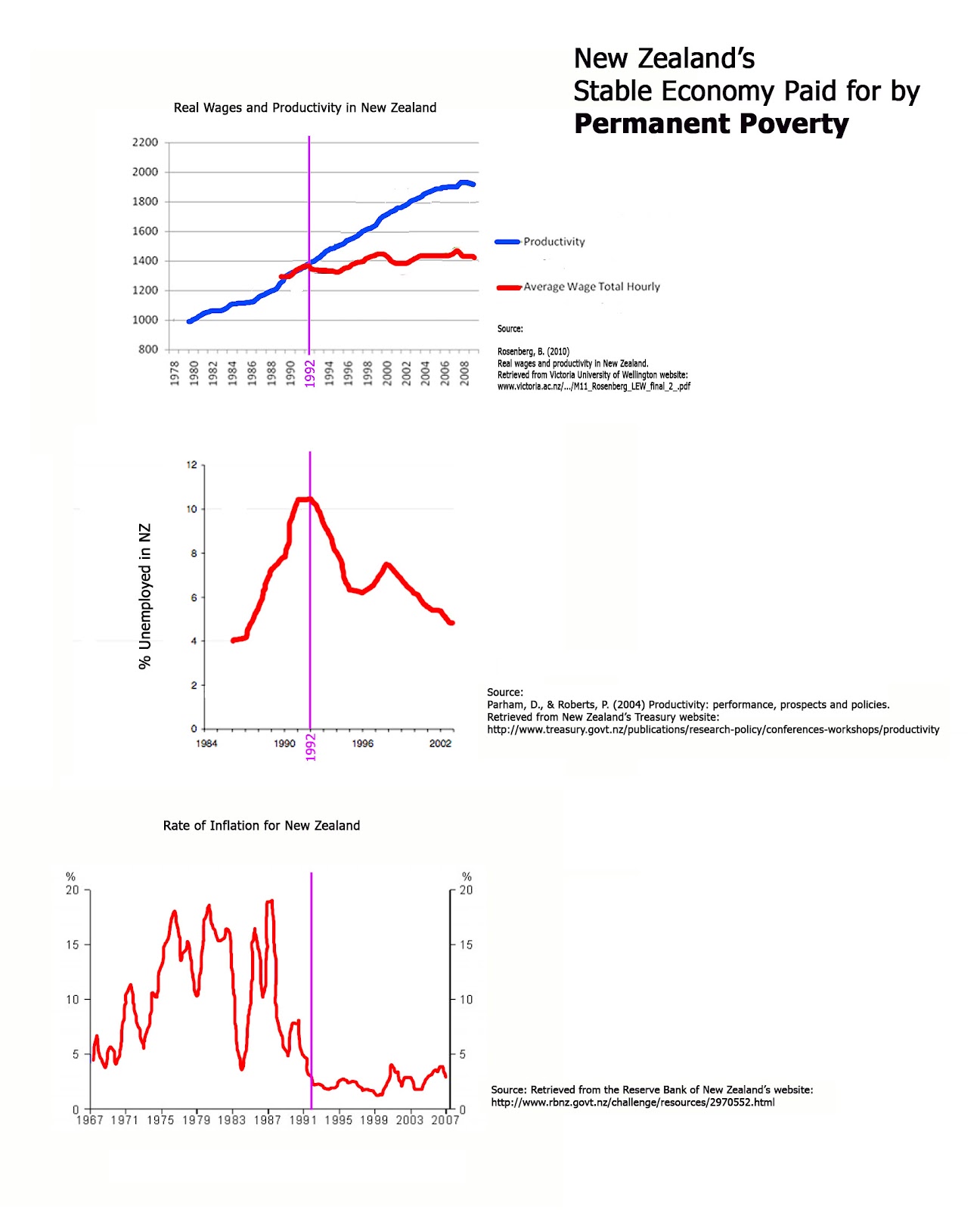
Stable Economy by Permanent Poverty. The N.A.I.R.U and the New Zealand Economy
Introduction
I am interested in exploring poverty in New Zealand and its intimate connection to wage rates, unemployment and inflation. Over the last thirty years in New Zealand we have undergone transformative reforms in the economic and welfare sectors. The effect has created a significant increase in the gap between rich and poor, to where today ours is one of the largest in the world (Donaldson & Hubbard, 2011), suggesting that we don’t have welfare in New Zealand, but well-orchestrated poverty.
Themes:
According to Bill Rosenberg, Economist and Director of Policy at the New Zealand Council of Trade Unions [CTU], wages rose on average according to the rate of productivity up until 1992. However, after 1992, productivity continued to rise at a steady rate, and wages on average did not (Rosenberg, 2010). If we look at data on the New Zealand Treasury website which shows us unemployment rates since 1986, we can see in 1992 the largest spike in unemployment in New Zealand history, with almost eleven percent of the population registered as unemployed (Parham & Roberts, 2004).
Could these two sets of data be related? According to Alister Barry in his documentary, In a Land of Plenty, they clearly are; “the reserve bank would manipulate interest rates so that at any given time one hundred to one hundred and fifty thousand kiwis would be unemployed....more unemployed people competing for jobs was bound to drive wages down” (Barry, 2002). A precedent was set that was then to become the norm.
But why would the government want New Zealanders to have a low wage? It is one way to control inflation, and maintain great wealth for the few (Barry). This is clearly demonstrated by the Non Accelerating Inflation Rate of Unemployment [NAIRU], which defines the lowest level of unemployment an economy can handle without causing rising inflation (Wikipedia.org, n.d.). New Zealand’s NAIRU is currently estimated to be five percent (Johnston, 2011), our current unemployment rate is 6.8% (Trading Economics, n.d.), and correspondingly our inflation is very low (Trading Economics). When unemployment was high in 1992, inflation dropped to its second lowest in New Zealand’s economic history (Trading Economics), thanks to the unemployed.
Current concern:
Right now New Zealanders have a new round of welfare reforms being implemented that continue the agenda set 1991. According to The New Zealand Herald, “anyone who turns down any offer of ‘suitable employment’ will have their benefit cancelled” (Collins, 2012). This is seen as a logical escalation of what was in place before; whereby the client was given “three chances” before they were cut. This reform continues to undermine the basic right of choice for a New Zealand citizen, as the Work and Income New Zealand [WINZ] case manager decides what is ‘suitable’ for the client.
Personal impact:
I was affected directly by the above scenario in 2010 as a person with part time employment (see www.wellsgroup.org) looking for full time work and receiving an unemployment benefit. After consultation with the Ministry of Social Development’s work brokers, where we discussed which were suitable and unsuitable jobs, I was immediately offered employment in the very role that I had identified as unsuitable due to my physical and mental health at the time. Despite there being many suitable jobs that I had expressed a direct enthusiasm for, I had no actual choice. Job ‘suitability’ was simply being used as a means to remove myself from their support. At the time I considered mine an isolated incident but having since worked alongside benefit rights advocates and meeting other cases, I understand this is an accepted procedure.
Conclusion:
In short I had refused to participate in what is now the very essence of welfare; a tool for applying pressure on existing jobs by falsely creating the impression that there are numerous able applicants available for a position. That pressure of course is applied using real people living on the margins of society in poverty. People growing more and more desperate and becoming increasingly prepared to accept lower and lower standards of living. This is the accepted way to manage the economy and control inflation. As Suzanne Snively of the Reserve Bank Board of Directors from 1985-92 has said: “...it was a manageable thing for the reserve bank to use employment and unemployment as a means to get wages down, it was far easier than any other means to get inflation down, so they used it” (Barry).
References:
Barry, A. (2002) In a land of plenty clip. [Videofile] Retrieved from http://www.youtube.com/watch?v=DcWl1rSVnYU
Collins, S. (2012). ‘One strike’ rule for beneficiaries. Retrieved from The New Zealand Herald website: http://www.nzherald.co.nz/politics/news/article.cfm?c_id=280&objectid=10834762
Donaldson, M., & Hubbard, A. (2011) Wealth gap divides nation. Retrieved from http://www.stuff.co.nz/national/4571384/Wealth-gap-divides-nation
Johnston, M. (2011) New Zealand’s NAIRU and youth unemployment. Retrieved from Econfix: http://econfix.wordpress.com/2011/07/06/new-zealands-nairu-and-youth-unemployment/
Parham, D., & Roberts, P. (2004) Productivity: performance, prospects and policies. Retrieved from New Zealand’s Treasury website: http://www.treasury.govt.nz/publications/research-policy/conferences-workshops/productivity
Rosenberg, B. (2010) Real wages and productivity in New Zealand. Retrieved from Victoria University of Wellington website: www.victoria.ac.nz/.../M11_Rosenberg_LEW_final_2_.pdf
Trading Economics. (n.d.). New Zealand unemployment rate. Retrieved from http://www.tradingeconomics.com/new-zealand/unemployment-rate
-->
Wikipedia.org. (n.d). NAIRU. Retrieved from: http://en.wikipedia.org/wiki/Nairu

Tuesday, October 2, 2012

Subscribe to:
Posts (Atom)